rtl-ready: جاهز للعربية
مهارة مفتوحة المصدر لـ Claude Code تجعل أي تطبيق ويب جاهزًا للغات التي تُكتب من اليمين إلى اليسار: العربية والعبرية والفارسية والأردية.
من ملف README
rtl-ready
Make any web app ready for right-to-left languages (Arabic, Hebrew, Persian, Urdu) with one Claude Code skill.


Translating the strings and adding dir="rtl" is the easy 10%. rtl-ready finds and fixes the
rest:
- margins and icons on the wrong side, and arrows that point backwards
- scrambled phone numbers
- Arabic letters torn apart by letter-spacing
- prices and dates in the wrong format
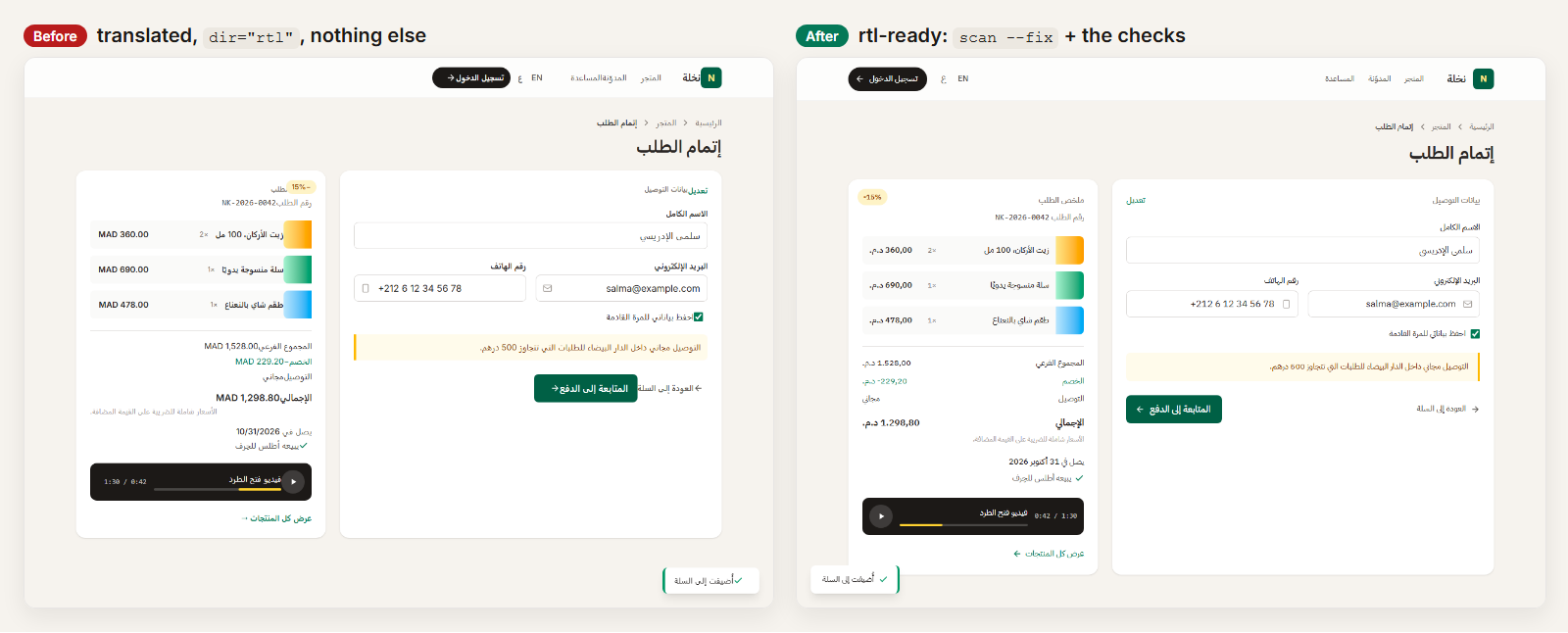
Live demo: rtl-ready.vercel.app shows the same page before and after, in English and Arabic.
بالعربية: مهارة مفتوحة المصدر لـ Claude Code تفحص تطبيق الويب، وتصلح ما يتعطّل عند الكتابة من اليمين إلى اليسار، ثم ترشد Claude إلى الباقي: الأيقونات، والأرقام والبريد الإلكتروني، والخطوط العربية، وتنسيق الأسعار والتواريخ.
What you get
- An audit with file:line.
scan.mjsis a zero-dependency Node script. It finds physical-direction code in Tailwind classes, CSS,<style>blocks, inline styles, React style objects and CSS-in-JS, and prints the logical replacement for each finding. - Safe automatic fixes.
--fixrewrites only drop-in replacements, such asml-4→ms-4,margin-left→margin-inline-start,text-left→text-startandfloat: right→float: inline-end. - Guidance for the judgment calls. The skill walks Claude through what a regex can't decide:
dir/langper locale- which icons to mirror (and which never to)
- LTR islands for phone numbers, emails, URLs and code
- bidi isolation and Arabic typography
Intlnumber and date formatting- forms, animations and component libraries
Before → after, for real
examples/before/ is a checkout page written LTR-first, the way most apps start. It only flips
dir for Arabic. This is what the skill did to it:
$ node skills/rtl-ready/scripts/scan.mjs examples/before
rtl-ready: 76 findings in 1 of 1 files · 57 fix · 15 check · 4 tip

examples/before/index.html:2:1      check  <html>  no lang: set it per locale …                 html-lang
examples/before/index.html:18:9     fix    float: right → float: inline-end                       css-physical
examples/before/index.html:39:24    fix    ml-3 → ms-3                                            tw-physical
examples/before/index.html:51:25    check  icon-arrow-right  directional icon: mirror it in RTL …  icon-mirror
examples/before/index.html:83:17    check  <input type="email" …>  emails, phone numbers and URLs are LTR …  input-ltr
examples/before/index.html:117:33   fix    right-4 → end-4                                        tw-physical
examples/before/index.html:185:77   tip    .toLocaleDateString()  pass the active locale …       intl-locale
…

$ node skills/rtl-ready/scripts/scan.mjs examples/after --fix    # on a copy of before/
rtl-ready: applied 57 safe fixes.
rtl-ready: 19 findings in 1 of 1 files · 0 fix · 15 check · 4 tip
The 19 remaining checks were then handled by hand, following the skill:
- mirror the arrows and chevrons, but not the play button or the checkmarks
- make the email and phone fields LTR
<bdi>around the order number- an Arabic font, line-height, and no letter-spacing for Arabic
Intlfor the prices (ar-MA→1.298,80 د.م.) and the date- a
--dirvariable for the toast animation
The page now scans clean:
$ node skills/rtl-ready/scripts/scan.mjs examples/after
rtl-ready: 1 file scanned, no RTL issues found ✓| English (LTR) | Arabic (RTL) | |
|---|---|---|
| Before | 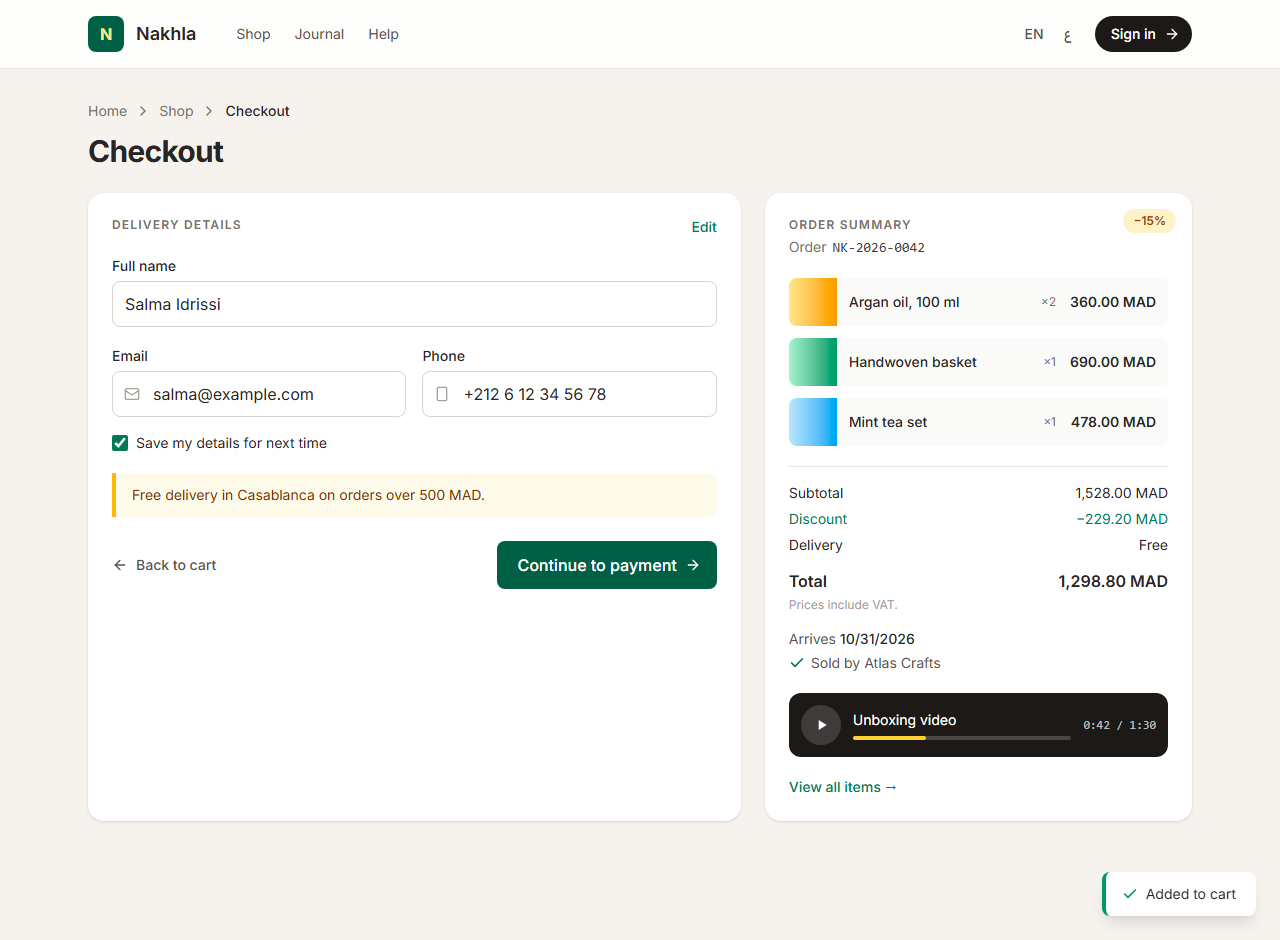 | 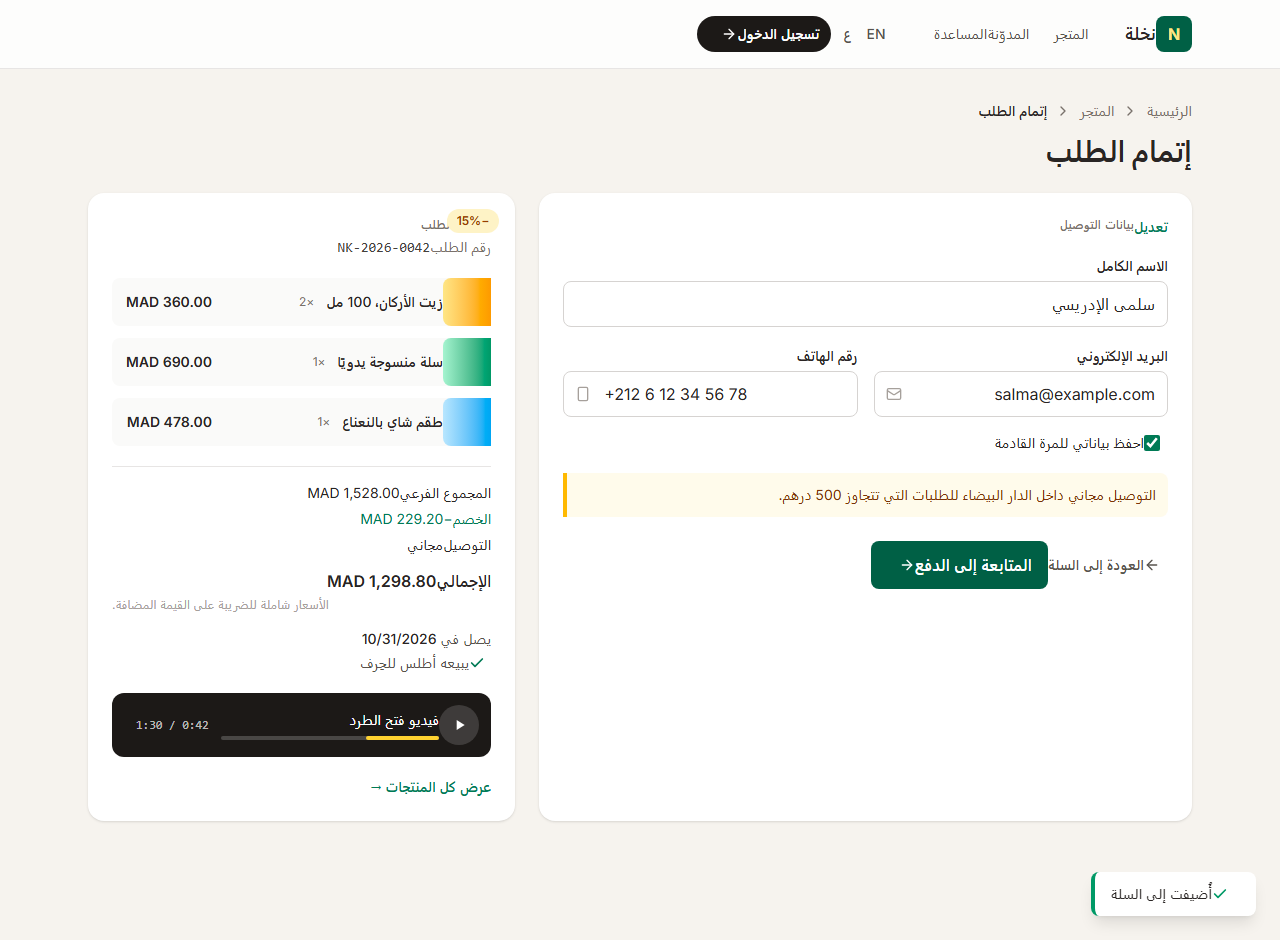 |
| After | 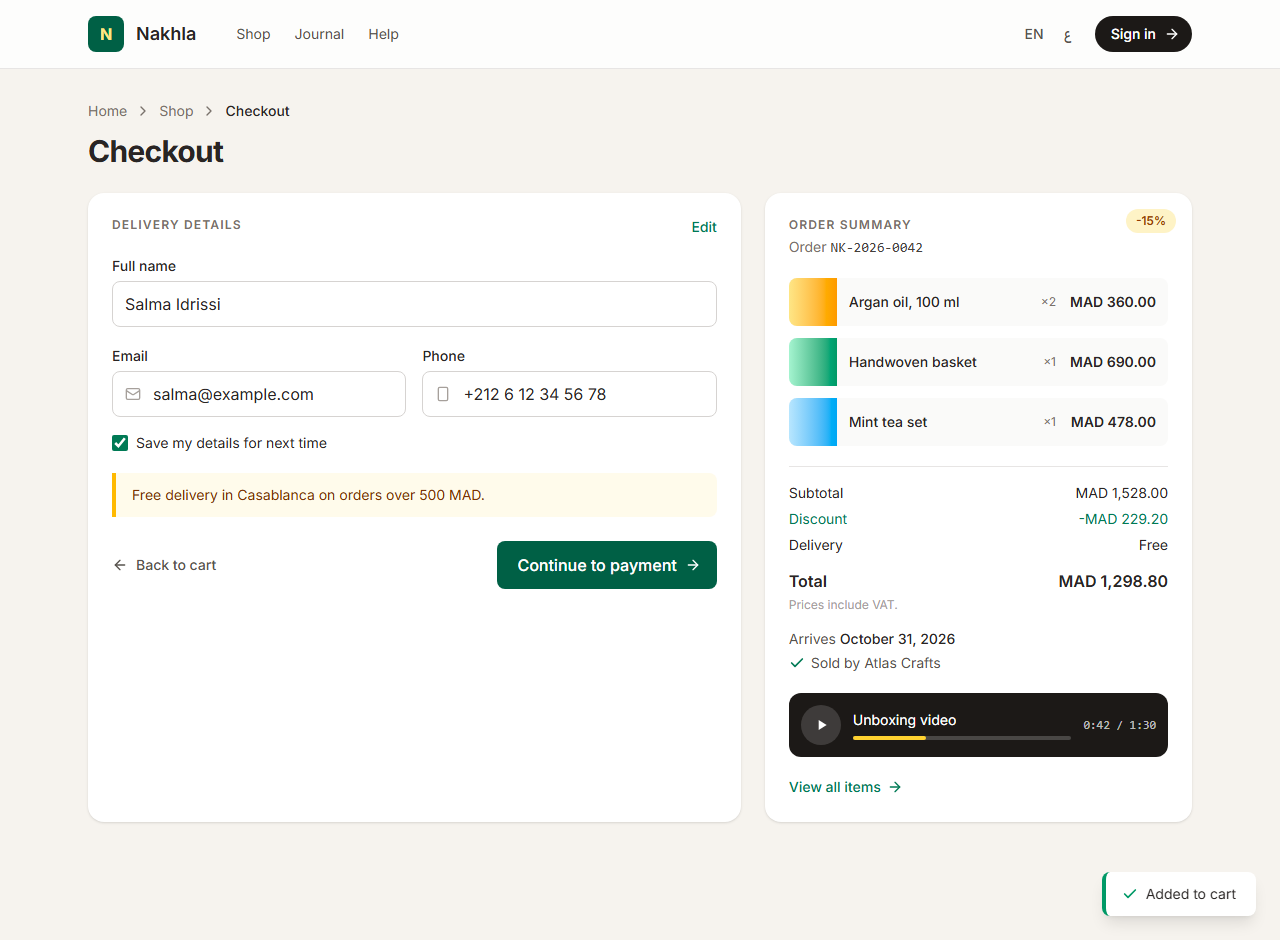 | 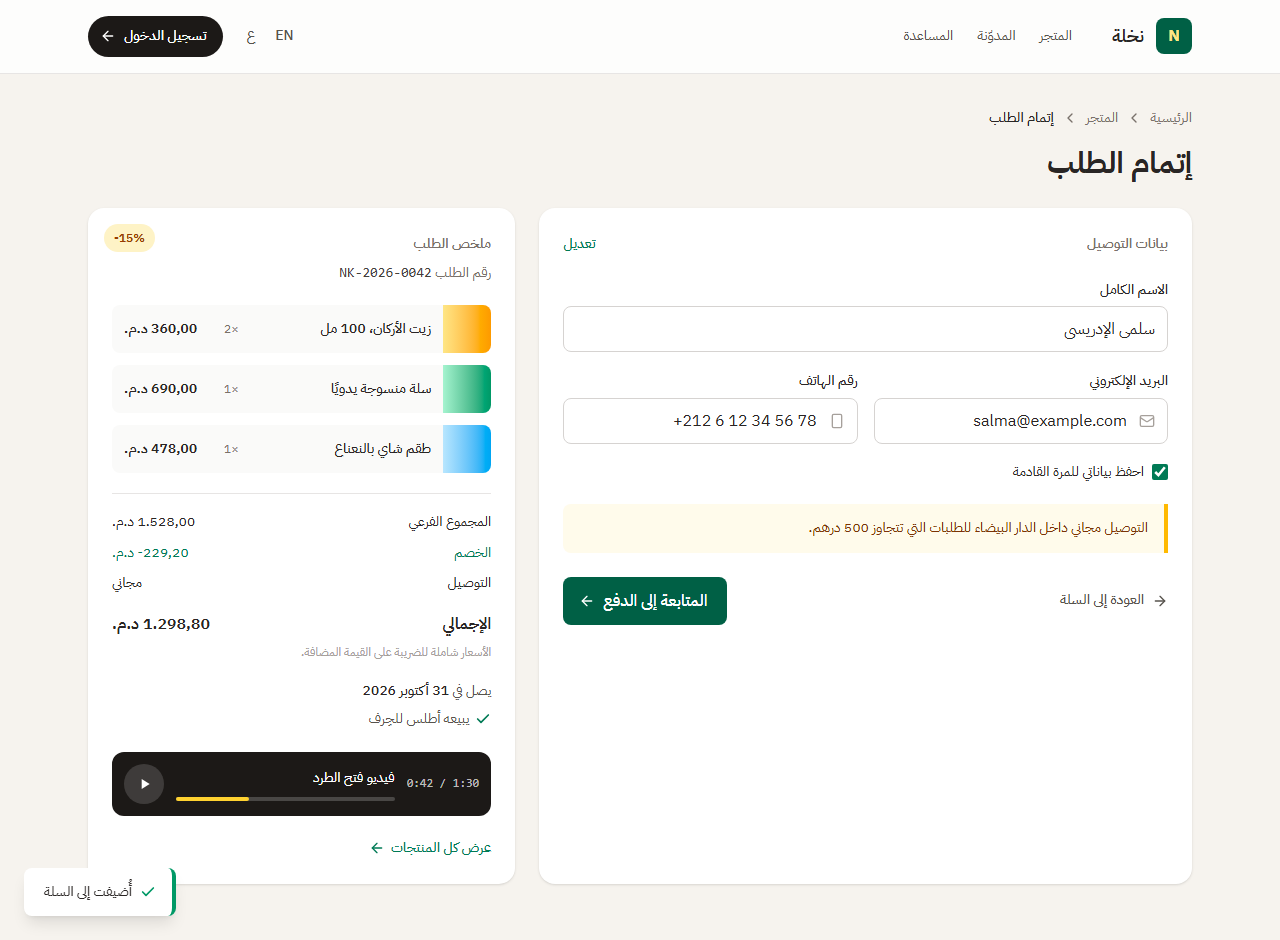 |
The full scan outputs are in docs/scan-before.txt and docs/scan-after-fix.txt.
Install
As a Claude Code plugin (recommended)
In Claude Code:
/plugin marketplace add miraya-dev/rtl-ready
/plugin install rtl-ready@rtl-ready
Or from a shell:
claude plugin marketplace add miraya-dev/rtl-ready
claude plugin install rtl-ready@rtl-ready
Claude uses the skill on its own when you talk about RTL, Arabic, Hebrew and so on. You can also
call it directly with /rtl-ready:rtl-ready. To update later, run
/plugin marketplace update rtl-ready.
Manually, as a personal skill
git clone https://github.com/miraya-dev/rtl-ready.git
cp -r rtl-ready/skills/rtl-ready ~/.claude/skills/
On Windows (PowerShell):
Copy-Item -Recurse rtl-ready\skills\rtl-ready "$HOME\.claude\skills\".
Call it with /rtl-ready. To share it with a team, copy it into the project's
.claude/skills/rtl-ready/ instead and commit it.
Just the scanner
skills/rtl-ready/scripts/scan.mjs is a single file that needs only Node 18.17+:
node scan.mjs src            # audit
node scan.mjs src --fix      # apply the safe fixes
node scan.mjs src --json     # machine-readable
Usage
Ask in plain words:
- "Add Arabic to this app and make the layout RTL-ready."
- "Our Hebrew pages look broken. Audit
src/and fix the RTL issues." - "Run rtl-ready on the checkout flow only. Apply the safe fixes and list what needs my decision."
- "Set
dirandlangper locale with next-intl." - "Review this branch for RTL regressions."
The skill's workflow:
- Learn the stack.
- Scan.
--fixthe mechanical part.- Work through each
checkwith the matching reference. - Cover a checklist of things no scanner sees.
- Verify in both directions and report what is left for you to decide.
How it works
skills/rtl-ready/
├── SKILL.md                 lean workflow + rules of thumb + checklist
├── scripts/scan.mjs         the scanner (zero dependencies)
└── references/              read only when needed (progressive disclosure)
    ├── logical-css.md       CSS, Tailwind v3/v4 and Bootstrap mappings; what to leave alone
    ├── mirroring.md         icons, transforms, animations, scrollLeft, keyboard, carousels
    ├── bidi-text.md         LTR islands, <bdi>, dir="auto", Intl, digits, forms
    ├── typography.md        Arabic/Hebrew/Persian/Urdu fonts, line-height, letter-spacing
    └── i18n-wiring.md       dir/lang with next-intl, i18next, Vue, SvelteKit, Astro; component libraries
What the scanner reports
| Level | Rule | Finds |
|---|---|---|
| fix | tw-physical | ml- mr- pl- pr- left- right- text-left float-right border-l rounded-r rounded-tl scroll-ml…, with variants, ! and negatives |
| fix | css-physical | margin-left, padding-right, left:, border-left-*, corner radii, text-align, float, clear, asymmetric margin: 0 8px 0 0 |
| fix | js-style | marginLeft, paddingRight, textAlign: "left", left: in style={{…}} |
| fix | bs-physical | Bootstrap 3/4 pull-right, rounded-left, border-right-0 |
| check | icon-mirror, arrow-glyph | arrow/chevron components and icon-font classes without rtl:-scale-x-100; → ← in text |
| check | tw-translate, css-translate, tw-gradient, tw-origin | horizontal motion, gradients and transform origins that don't flip |
| check | input-ltr | email, phone and URL inputs without dir="ltr" |
| check | html-dir, html-lang | <html> without dir/lang |
| check | css-rtl-override, tw-space-x | [dir=rtl] overrides to delete; space-x-reverse (and v3 space-x) |
| tip | letter-spacing, intl-locale | tracking on text that may be Arabic; toLocaleString() without a locale |
It also knows what to leave alone:
- symmetric utilities (
mx-,inset-x-0) - centring (
left-1/2 -translate-x-1/2) rtl:/ltr:variants, and Radixdata-[side=left]:variants[dir=rtl]rules and comments- TypeScript types like
{ left: number }
Options:
--min fix|check|tip--ignore <path-part>--tailwind 3|4(read frompackage.jsonby default)--exit-zero
Exit codes: 1 when fix/check findings remain (useful in CI), 2 on usage errors.
To silence a line, add a comment that contains rtl-ready-ignore. rtl-ready-ignore-next-line and
rtl-ready-ignore-file work too, and rtl-ready-ignore-start … rtl-ready-ignore-end silence a
block, such as an HTML email template. Say why in the comment.
Limitations
- Heuristic, not a full parser. The scanner uses careful regexes. It misses classes built at
runtime (
`ml-${n}`), styles assembled across files, and custom Tailwind plugins. Run it, then let the skill's checklist cover the rest. - Icons are found by name. Inline
<svg>without a telling class, images, canvas and charts are not detected. The checklist asks Claude to look. --fixis deliberately narrow. Transforms, icons, inputs, typography and[dir=rtl]overrides always stay for review.- Bootstrap 5 compiles its logical names to physical CSS, so RTL pages also need
bootstrap.rtl.min.css. - HTML emails keep physical properties, because many email clients ignore logical ones.
Silence those files, or wrap the template in
rtl-ready-ignore-start/rtl-ready-ignore-end. - Web only. React Native, Flutter and native apps have their own RTL systems.
- It does not translate your strings.
Contributing
Issues and pull requests are welcome, especially from people who read Arabic, Hebrew, Persian or
Urdu every day. See CONTRIBUTING.md. Tests run with npm test (node --test),
and nothing needs to be installed.
License
MIT © 2026 Moncef El hirech (Miraya)
Built by Miraya, an Arabic-first product studio. The demo shop, its products and its people are fictional.